Why Jigsaw Puzzles Relax Your Brain: The Quiet Science of Flow
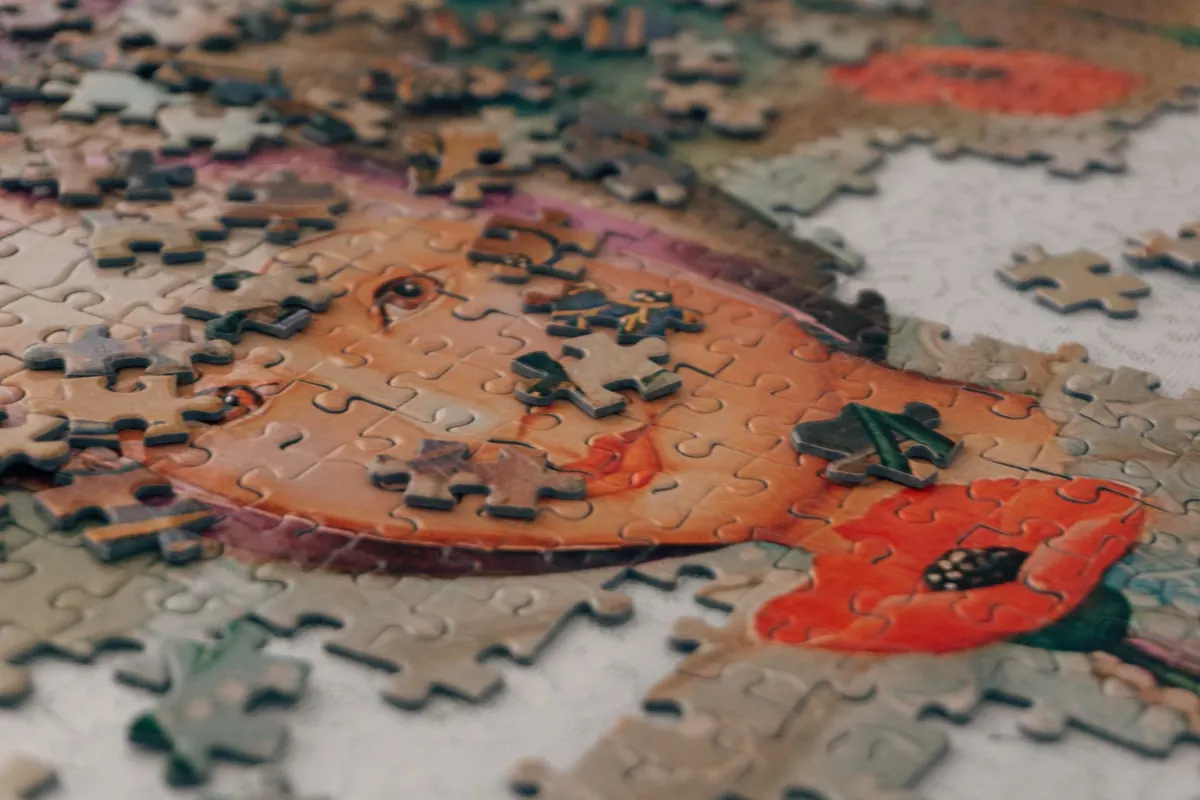
The box lands on the table with a sound like a deck of cards dropped from a height. A thousand pieces, mostly sky, and for a moment it looks like a mistake. Then you turn the first piece over, and something in your head settles. Not because the puzzle is easy — it isn't — but because it asks for exactly one thing at a time, in a language your brain already speaks: shape, colour, fit.
Starting Is Mostly Sorting
Nobody solves a jigsaw in the order it will eventually appear. The first half hour is administration, and that's the point.
You tip the pieces out, turn them face-up, and start making piles. Flat edges go together. Pieces with a patch of tree bark go together. There's a small heap for the dark shadow under the bridge, and a larger one for the parts of the sky where the blue changes slightly. Sorting is repetitive, mildly absorbing, and almost impossible to rush. That's a feature, not a delay.
A simple first pass looks like this:
- Edges first. Separate everything with a straight side. These build the frame and give the rest of the puzzle a place to live.
- Colour zones. Sky, grass, clothing, water, the busy patterned area you'll deal with later.
- Anything with text or a strong line. Signage, windows, stripes, ropes, roof tiles. These pieces are easy to place and they teach you how the illustration works.
- The rest. Don't sort the rest. Leave it face-up in a shallow pile and let it wait its turn.
Within twenty minutes the room has gone quiet, your shoulders have dropped, and you haven't thought about your inbox once.
Why Small, Low-Stakes Decisions Feel So Good
Most of the choices you make in a day carry weight. What to reply, what to book, what to tell someone, what to spend. They're tangled up with consequences and other people.
A puzzle piece is a decision with no stakes at all. It fits or it doesn't. If you're wrong, you put it back and pick up another one. Nothing is wasted, nothing is recorded, and no one is waiting for an answer. You get to make hundreds of tiny judgements in an hour and none of them can go badly.
That's more restful than it sounds. Decision fatigue is real, and a task where every choice is reversible and consequence-free gives that part of your mind a break without asking it to do nothing.
Flow, Without the Mystique
Psychologists use the word flow for the state where time thins out and the work absorbs you. The conditions are unglamorous: a clear goal, feedback that arrives immediately, and a challenge that sits just at the edge of what you can currently do.
Jigsaws hit all three.
The goal is visible on the box lid. The feedback is instant and physical — the piece either slides in or it doesn't, and the click tells you before your brain does. The difficulty scales with your choice: a 500-piece puzzle with strong colour blocks will keep momentum for an evening, while a 1000-piece with a large gradient sky will slow you down to a crawl and demand real scanning.
Flow isn't a mystical state. It's a description of attention that has stopped being divided. For most people, that's rarer than it should be, and it's the main reason an hour with a puzzle feels different from an hour with a phone.
What Your Hands Are Doing While Your Mind Quiets
Puzzles are not purely mental. You're picking pieces up, rotating them, feeling the cut of the cardboard, comparing a curve against a hole. Your eyes sweep the table in slow arcs. Your hands keep a rhythm.
That physical component matters. Sitting still and trying to "relax" is often harder than doing something gentle with your hands. The body stays occupied, so the mind stops fidgeting.
It also explains why a puzzle can sit alongside other quiet input — a podcast, an album, a conversation — better than reading can. On the fiddly sections, though, try silence. The gradient sky has nothing to say, and neither should you.
Progress You Can See
Few things in adult life display their progress so plainly. Most work disappears into files and threads and half-finished thoughts. A puzzle accumulates in front of you.
By nine o'clock the sky has a corner. By tomorrow it will have a horizon. You can point at what you did, and no one has to approve it, review it, or reply to it. That visible accumulation is quietly satisfying in a way that's hard to manufacture elsewhere, and it's part of why the last twenty pieces feel so good to place.
What a Puzzle Won't Do
It isn't therapy, and it isn't a cure for a bad week. It's a good hour. If low mood or anxiety is persistent, or if you're using puzzle time to avoid something that genuinely needs attention — a conversation, an appointment, a decision — talk to a doctor or a qualified professional. A table full of cardboard is a fine place to rest; it isn't a treatment plan.
Two practical cautions. Sit so your back is supported and your forearms aren't floating. And every half hour or so, stand up, roll your shoulders, and look at something across the room rather than at the table.
Setting Up a Session That Actually Restores You
The puzzle itself does most of the work. A few small choices help it along.
- Pick for finishability. A puzzle you can complete in three or four sittings keeps momentum. A 2000-piece panorama in muted tones will stall and start to feel like a chore.
- Find a surface you can leave. A jigsaw that must be packed away every evening loses its thread. A board, a spare table, or a felt mat you can slide under the sofa makes a real difference.
- Light the table, not your face. A lamp aimed at the pieces beats overhead light for contrast and eye comfort.
- Set a stopping point you can see. "Until the frame is closed" or "until this section is done" gives the session a natural end, so you stop by choice rather than exhaustion.
- Drop the scorekeeping. No timer, no rush, no progress photo for anyone. The moment it becomes a performance, the calm leaks out.
Then sit down, tip the box out, and start sorting. The first ten minutes are the price of entry. After that, the room tends to take care of itself.
Photo: Berna / Pexels