Cross-Stitch vs Embroidery: Which Handcraft Should You Learn First?
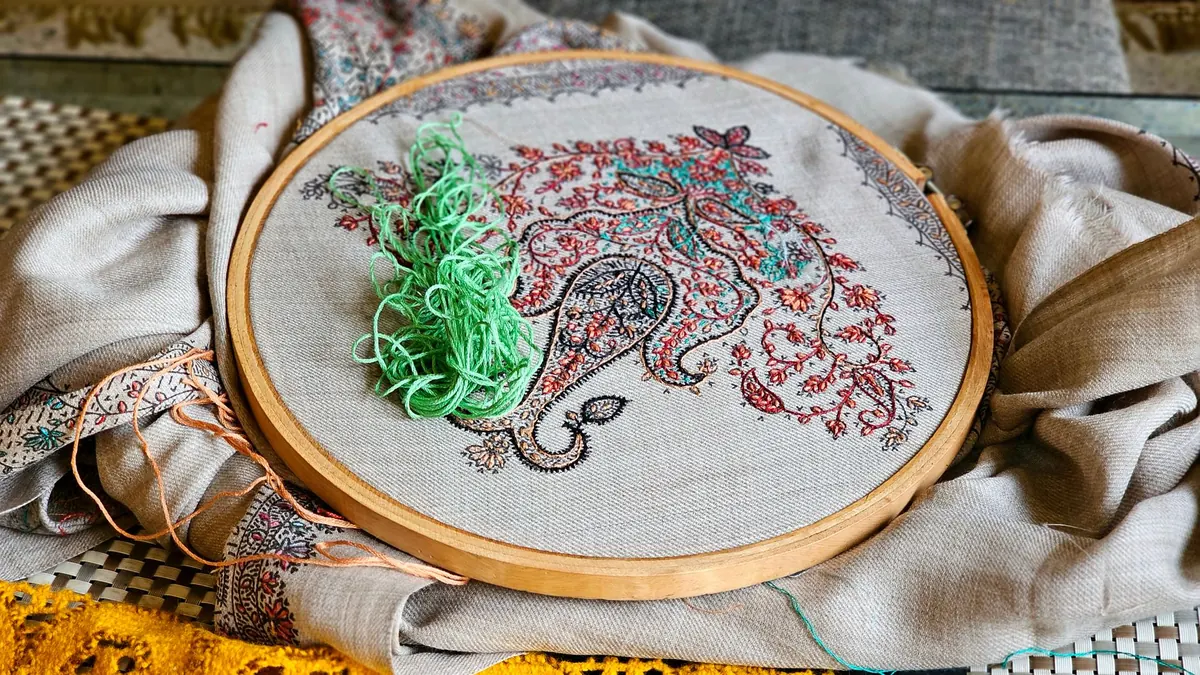
A needle, a length of thread, a scrap of fabric: from across the room, cross-stitch and embroidery look like the same hobby. Up close, they ask for different things. One rewards careful counting and a tolerance for repetition. The other rewards a steady hand and the willingness to make decisions stitch by stitch. If you are standing in a craft shop holding two kits and a budget for one, here is what actually separates them.
The Quick Verdict
Cross-stitch is the easier craft to teach yourself. The pattern is a chart, the fabric has visible holes in a grid, and every stitch is the same X. You can put it down mid-row, come back a week later, and know exactly where you are.
Embroidery is more flexible and, for many people, more interesting over the long haul. You are not filling in squares; you are drawing with thread. That freedom is the whole appeal, and also the reason beginners get stuck. There is no chart telling you that the next stitch should be three millimeters long and angled slightly left.
Neither is better. They just suit different temperaments.
What You Are Actually Making
Cross-stitch has a distinctive, slightly pixelated surface. The Xs lock together into blocks of color, so the texture is even, geometric, and unmistakable. Think samplers with alphabets and borders, small framed motifs, quotes stitched for a nursery wall, or a tiny heart finished in a three-inch hoop and hung from a ribbon.
Embroidery reads as fluid line and shape. A stem in stem stitch curves; a leaf in satin stitch catches light; a scattering of French knots gives a lavender sprig real dimension. You can embroider a monogram on a shirt cuff, add wildflowers to a denim jacket pocket, or fill a hoop with a botanical study in six shades of green.
Both look handmade, but they do not look alike. Cross-stitch looks constructed. Embroidery looks drawn.
Tools: Almost the Same Shelf
The supply overlap is large, which is why trying both is cheap once you have a basic kit. The differences matter, though.
- Fabric. Cross-stitch wants an even-weave cloth with countable holes — Aida is the standard beginner choice, usually 14 holes per inch. Embroidery will work on almost anything with a bit of body: cotton, linen, felt, denim, a sturdy shirt.
- Needles. Cross-stitch uses a blunt tapestry needle, size 24 to 26, so it slips between threads instead of piercing them. Embroidery uses sharp needles, and the size shifts with the fabric and thread.
- Thread. Both typically use stranded cotton floss, sold in skeins and split into individual strands. Cross-stitch usually calls for two strands. Embroidery might use one for fine detail and all six for a bold fill.
- Hoop. A four- to eight-inch hoop suits both. Embroidery is almost always worked taut in a hoop; cross-stitch can be worked in the hand if you prefer.
- Extras. Small sharp scissors, a needle threader, and a water-soluble fabric marker for embroidery. Cross-stitch adds a printed or PDF chart, plus a highlighter to mark off completed rows.
Difficulty: Two Different Kinds of Hard
Cross-stitch: the counting problem
The stitches themselves are simple. The challenge is bookkeeping. Miscount by one square and a whole section shifts, which is why most beginners learn to mark the center of the fabric and the center of the chart before the first stitch. The other habit worth building early: keep every bottom leg of the X angled the same direction. It is invisible in a photo and obvious in person.
Embroidery: the judgment problem
Nobody tells you how long the next stitch should be. That is the real learning curve. Start with a sampler of six basic stitches — running, backstitch, stem, satin, lazy daisy, French knot — on a scrap of cotton. Do each one across a row. By the third attempt your hands will have figured out tension, which is most of the craft.
Common beginner trouble in both: thread cut too long. Keep working lengths to about eighteen inches. Longer thread tangles, frays, and thins out, and thin thread shows in the finished piece.
Time, Pace, and Where You Can Stitch
Cross-stitch is slower per square inch, and it shows you progress in tidy increments. A row completed is a row you can see. For a lot of people that is exactly why it is restful: there is a rhythm to it, and watching a series is entirely compatible with stitching a block of one color.
Embroidery moves faster on small work. A sprig of leaves can be finished in an evening, which makes it satisfying for gifts and for testing ideas. It is also easier to pick up and set down, since you rarely need to study a chart before making the next stitch.
Mistakes feel different too. Cross-stitch errors are usually fixable by unpicking a few Xs and redoing them — tedious, not painful. Embroidery errors are harder to remove invisibly, but many can be stitched over with a slightly fuller shape, which is a generously forgiving feature.
Which One Should You Learn First?
- Choose cross-stitch if you like following instructions, find repetition calming, want a finished object that looks crisp and deliberate, and would rather not make aesthetic decisions while your hands are busy.
- Choose embroidery if you get bored doing the same motion, want to draw, like texture and shading, and can tolerate a little wobble in your first attempts.
- Consider a middle path if you are genuinely torn: start with a small cross-stitch kit to lock in tension, threading, and how to start and end thread without knots, then move to an embroidery stitch sampler. The fundamentals carry over, and the second craft will feel surprisingly familiar.
Start Small, Then Let the Craft Decide
Buy one kit, not a stash. A single hoop, one pack of needles, and the floss the pattern actually lists is enough to find out whether you enjoy this. Pick a design that takes two or three evenings, not two months — a small motif, a bookmark, a five-stitch sampler. Beginner kits overshoot on ambition far more often than they overshoot on difficulty.
Set aside twenty or thirty minutes rather than a whole afternoon. Stitching is a slow pleasure, and short sessions keep your attention on tension instead of speed. Wash your hands first; oils dull thread over time. When you stop for the day, park the needle at the edge of the fabric rather than through the middle of finished stitches, and avoid dragging thread across the back of a gap — it shows through on light fabric.
Finally, press your finished piece face down on a folded towel, with a warm iron and no steam, before you frame or hoop it. It is the step beginners skip and the one that makes the difference between homemade and handmade.
Whichever you pick, the first stitch is the hardest. The rest is just time, and time is what this hobby is for.